

Reviewed · WALKING TOURS
Central Oslo Guided Walking Tour with Local Guide
Oslo has a knack for mixing big-city energy with old streets, and this guided walk is a clean way to connect the dots fast. You start in the middle of it all, then move through the sights that shape how Oslo feels day to day.
I love the Tiger Sculpture moment, because it immediately explains why the city is nicknamed Tiger City. I also love that this is run by real people with names like Suzanne, Daniel, and Marta, who keep history moving with humor and good answers.
My one caution: this is an outside-only tour. You’ll get the context and the best viewpoints, but you do not go inside the buildings.
Key highlights worth showing up for
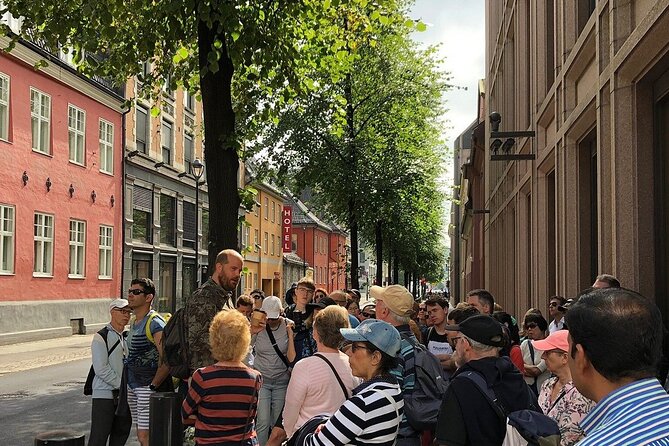
- Tigeren at Jernbanetorget: Oslo’s Tiger City symbol, erected in 2000 for the millennium
- Oslo Opera House waterfront views: a 2008 architectural landmark you can enjoy from the edge
- Rådhusgata to Oslo City Hall: a walk past streets tied to the city’s civic core, plus the Nobel Peace Prize connection
- Akershus Fortress area: late 13th-century protection history, framed in a way you can actually remember
- Aker Brygge waterfront district: from shipyard roots in 1854 to an entertainment and dining zone since the 1980s
- Storting and the Royal Palace finale: Norway’s Parliament and your last big postcard view
Oslo in two hours: why this route works
This tour is built for first-time orientation. In about 2 hours, you cover central landmarks that are spread out enough to feel like a real day’s worth of sightseeing, yet compact enough that you are not wasting time on logistics.
The start point also helps. Meeting at TigerJernbanetorget puts you by a major transport hub, so you can get oriented immediately and adjust if your plans change. And because the tour ends at Slottsplassen 1 in front of the Royal Palace, you finish in the exact area you will likely loop back to later.
I like that the pacing is designed to keep you moving, but not sprinting. It is the kind of walk where you can still ask questions and not feel like you missed the key story.
More Walking Tours in Oslo
- Oslo: Guided Walking Tour of Central Oslo with Local Guide
★ 4.7 · 936 reviews - Oslo: Best of Oslo Walking Tour
★ 4.5 · 458 reviews - Oslo: Historic Myths & Legends Evening Walking Tour
★ 4.8 · 408 reviews
Tigeren pa Jernbanetorget: the Tiger City intro you will actually remember
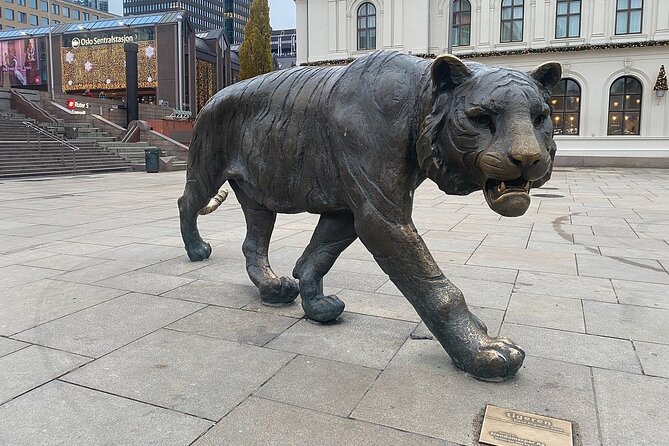
The walk begins at Tigeren, the Tiger Sculpture at Jernbanetorget. It was erected in 2000 to commemorate Oslo’s millennium, and it is tied to the nickname Tiger City.
This stop matters because it gives you a quick mental shortcut. Once you understand the Tiger City idea, the rest of central Oslo clicks into place as a planned, modern capital that still respects its identity. It is an easy win, and it sets a tone that is fun without feeling like a gimmick.
You also get your first sense of Oslo’s layout right away. The station square makes it clear where the city’s big pedestrian routes lead, and you start building a sense of direction before the tour moves into the historic center.
Oslo Opera House and the waterfront: modern architecture with context
Next up is the Oslo Opera House, completed in 2008 and known for its contemporary design and waterfront setting. Even if you have seen photos, you will likely notice how the building sits against the water and how the surroundings frame it.
This is a strong stop for two reasons. First, it gives you a visual contrast to the older landmarks you will see later. Second, it is a practical navigation anchor, because many of the walkable routes in central Oslo relate back to this area.
One outside-only note: you will not be doing an interior visit here on this tour. Still, the exterior viewpoint is where the architecture story starts, and the guide helps you understand what to look for instead of just snapping pictures.
Rådhusgata and City Hall: how Oslo runs on civic pride
From there, you move along Rådhusgata, a historic street dating to the 1620s that leads toward Oslo City Hall. Streets like this can look like any other central lane until someone explains why they were laid out and how they guided civic life.
You then reach Oslo City Hall, a major landmark constructed between 1931 and 1950. It is famous for hosting the Nobel Peace Prize ceremony annually, which turns a municipal building into something you can feel connected to even if you never visit an embassy or palace.
This stop is a great place to ask questions. City buildings often make more sense once you connect them to how public events and national attention happen in real life. You also get that Norse practical vibe, where institutions are visible and part of the daily city picture.
Different weather, different plan? Oslo also runs these:
- Oslo: Oslo Fjord Sightseeing Cruise by Sailing Ship
★ 4.5 · 5,790 reviews - Oslo: Scenic Fjord Cruise with Audio Guide Commentary
★ 4.5 · 5,375 reviews - Oslo Nature Walks: Island Hopping Tour
★ 4.8 · 2,713 reviews - Oslo: 24 or 48-Hour Hop-On Hop-Off Sightseeing Bus GrayLine
★ 4.0 · 2,088 reviews
Akershus Fortress: medieval defense, explained for modern visitors
The route brings you to the Akershus Fortress area, a medieval castle built to protect Oslo from invasions. It dates to around 1299, and over the centuries it has served as a military base and prison, and today it functions as a museum and historical site.
Here is the key reality check: this tour is outside-only. So you will get the big fortress framing and the history through the guide’s storytelling, but you should not expect interior access during the walk.
Still, this is worth your time because Akershus changes the scale of what you are seeing. You go from streets and civic buildings to a reminder that Oslo’s core was shaped by defense and geography long before modern tourism existed. When you have that in your head, the rest of central Oslo feels less random.
Oslo Cathedral: Baroque architecture and the role of faith
Next is Oslo Cathedral, originally built in 1697. The architecture is Baroque, and the building has gone through renovations, including major work in the 20th century.
Even from the outside, a cathedral stop like this works best when you understand what renovation means in a living city. Oslo Cathedral is not frozen in time, it keeps being maintained and reinterpreted, and that is part of how you should read the monument.
One outside-only consideration applies here too. If you want a fully inside experience, plan an additional stop on your own. But if your goal is orientation and context, this cathedral moment helps you understand Oslo as a capital with layered eras.
Karl Johans gate: the main street where everything seems to converge
You then walk through Karl Johans gate, Oslo’s main street. It stretches from the Royal Palace area to Oslo Central Station and was established in the 19th century, with historic buildings, shopping, dining, and cultural stops along the way.
This is a practical section of the tour. Karl Johans gate acts like a spine, and once you walk it with context, you can use it later to plan your own routes without getting lost.
Also, it is an easy place to reset your eyes. You have already absorbed fortress and institutional architecture, and now you are back in the street-life rhythm of the city.
Aker Brygge: from shipyard past to waterfront fun
After the historic core feel of Karl Johans gate, you arrive at Aker Brygge. This waterfront district used to be a shipyard founded in 1854, then it was transformed into today’s shopping, entertainment, and dining area in the 1980s.
This stop is where Oslo starts to feel like a modern place you can enjoy, not just a place you study. The guide’s storytelling helps you see the transformation in one mental sweep: industrial roots, then redevelopment, then a public-facing waterfront.
The outside-only format actually fits this district well. Aker Brygge is best experienced by walking, looking at the water, and spotting the variety of storefronts and hangout spaces around you.
The Storting and the Parliament story you can see from street level
You continue to the Storting building, the seat of Norway’s Parliament. It was built between 1861 and 1866 and is a strong example of 19th-century architecture, designed to signal legislative authority and democratic values.
This is a good moment to pay attention to how public power looks in different countries. Some capitals hide their government, others place it in plain view, and Oslo clearly leans toward visibility and ceremony.
You will not be going inside on this tour, but you can still grasp the meaning behind the architecture when you understand what it was built to represent.
Finishing at the Royal Palace: your final big viewpoint
The tour ends in front of Det Kongelige Slott, the Royal Palace, at Slottsplassen 1. This is a great finish because you do not stop at a random corner. You end at the landmark that anchors much of central Oslo, and it becomes a natural meeting spot for your later plans.
From a practical standpoint, finishing here helps you because the palace area is centrally positioned for further sightseeing and walking. If you want to keep going after the tour, you are already placed where many easy routes branch off.
Also, if you took the tour early in your trip, this ending gives you a sense of closure. You now know the core landmarks, and the rest of the days can be filled with more specific interests.
Price and value: is $16.94 a smart spend?
At $16.94 per person for about 2 hours, this tour is priced like a high-value orientation tool, not like a museum day. For that money, you get a local guide for the whole walking time and a structured route through major sights without having to piece it together yourself.
You also benefit from a “pay once, learn a lot” format. The tour is built around key stops, and the guide adds meaning to each one so you remember more than you would after a solo walk.
If you love history, architecture, and city layout, it is a strong deal. If your goal is strictly interiors and ticketed exhibits, you may feel limited because the tour does not include visits inside buildings.
What group size and audio mean for your comfort
This experience runs in English and has a maximum group size of 27 travelers. A group that large is not huge, but it is also not tiny, so you will want to be slightly mindful about where you stand if you prefer a clear view and easy listening.
From real on-the-ground patterns, the guides use microphones or speaker systems to help you hear in city noise. That helps a lot, especially when streets get busy or when weather is less cooperative.
As for the walking itself, it is manageable for most travelers. It is still a city walk with multiple blocks and stops, so if you have mobility challenges, you will want to plan around stairs and uneven sidewalks as you move.
Who this tour fits best
This is ideal for your first day in Oslo, especially if you want to get oriented without spending hours on planning. It is also a good fit if you enjoy humor and conversational explanations, since multiple guides have been praised for blending facts with a light touch.
You will likely enjoy it most if you:
- Want a central Oslo route you can repeat later on your own
- Like seeing a mix of modern and historic landmarks
- Prefer guided context over reading at every stop
- Want a manageable time commitment at 2 hours
If your priority is inside-only museum time, you will need to pair this with separate tickets for the places that offer them.
Should you book this Central Oslo guided walk?
Yes, if you want a smart first-day experience that helps you understand Oslo’s layout and landmarks quickly. The price is reasonable for what you gain, and the route covers the kind of iconic stops that anchor a trip.
Book it if you value outside viewpoints plus a guide who can turn buildings and streets into stories you remember, with a tone that keeps the walk fun. Skip it if you specifically want interior access and ticketed building visits, because this tour keeps you on the outside.
If you want an efficient way to build your Oslo map and then explore more on your own, this one is an easy yes.
FAQ
How long is the Central Oslo guided walking tour?
It lasts about 2 hours.
Where does the tour start and end?
It starts at TigerJernbanetorget (0154 Oslo) and ends in front of the Royal Palace at Slottsplassen 1 (0010 Oslo).
Is the tour offered in English?
Yes, it is offered in English.
What is the price per person?
The price is $16.94 per person.
How many people are in the group?
The tour has a maximum of 27 travelers.
Does the tour include visits inside buildings?
No. The tour does not include visits inside any buildings.
Is a mobile ticket used?
Yes, it uses a mobile ticket.
Is it suitable for most travelers?
Most travelers can participate.
Can I bring a service animal?
Yes, service animals are allowed.
What if the weather is poor or I need to cancel?
The experience requires good weather, and if it is canceled due to poor weather you will be offered a different date or a full refund. Free cancellation is available up to 24 hours before the start time for a full refund.
Freshly reviewed in Oslo
- Oslo City Highlights with Fjord Cruise★ 4.5 · 128 reviews
- Oslo: Oslo Fjord Cruise with Live Jazz Music & Shrimp Buffet★ 4.4 · 143 reviews
- From Oslo: Oslomarka Forest Guided Snowshoeing Tour★ 4.8 · 161 reviews
- Oslo Fjord Evening Cruise with Shrimp Buffet on a Sailing Ship★ 4.0 · 170 reviews
- Oslofjord Sightseeing★ 4.0 · 170 reviews
- Oslo: City Highlights Walking Tour★ 4.8 · 197 reviews
- Oslo: Snowy Forest Torchlight Walk with Campfire★ 4.6 · 254 reviews
- Oslo: Private Walking Tour with a Local★ 4.5 · 263 reviews
Walking Tours, compared.
Past & Present Small Group Guided Walking Tour
Read our review →
Walking Tour in Bergen of the Past and Present
Read our review →
Guided Walking Tour of Central Oslo with Local Guide
Read our review →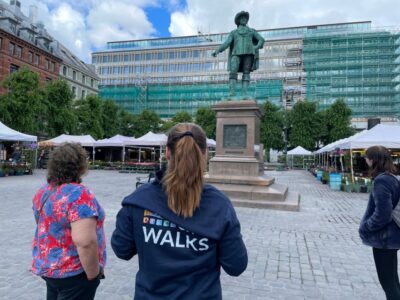

Browse the lists this tour appears in